Is it possible to Text mine the tweets to understand peoples’ feelings towards a brand?
Yes, it is possible to understand what type of feelings people are expressing regarding any brand from the tweets of Twitter. I am going to demonstrate the example of Ben & Jerry’s below.
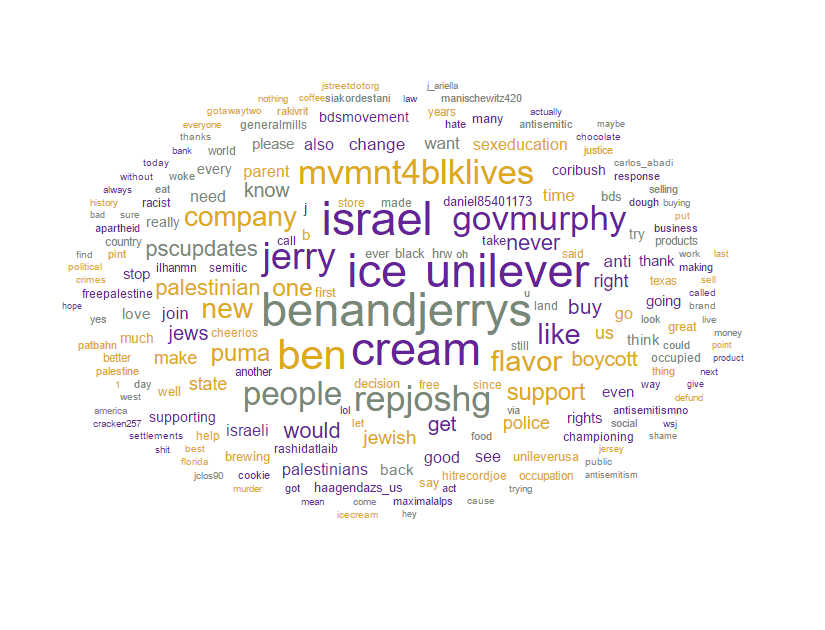
We have collected 6000 tweets from Twitter that use the keyword Ben & Jerry’s. the following picture is the word cloud result ( larger font size represents words more frequently used in this word cloud), which shows us what people are talking about Ben & Jerry’s.
Word Cloud of Ben & Jerry’s
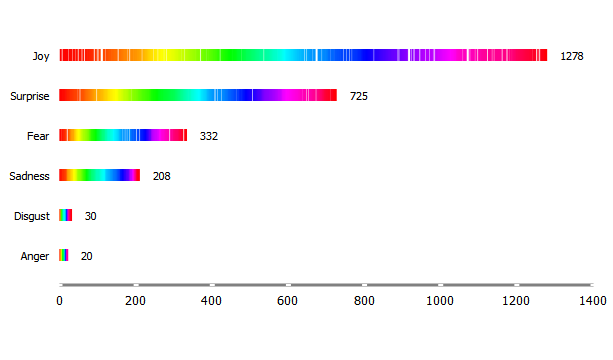
We are going to demonstrate in the following picture what type of feelings consumers are expressing on Twitter related to Ben & Jerry’s.
People’s Feelings related to Ben & Jerry’s
From the above results of text mining, we can understand that people are expressing more joy and surprise feelings related to Ben & Jerry’s brand and it represents a good reputation for the brand.
Measuring public opinion was always about extrapolating from surveys and hoping the small sample you selected was representative of the general public. Today, individual public opinion is ripe for the taking on Facebook, YouTube, Instagram, Twitter, Reddit, WhatsApp, and whatever new product review or augmented-reality platform pops up next.
With the advancement of Artificial Intelligence, we can now analyze texts using different types of software.
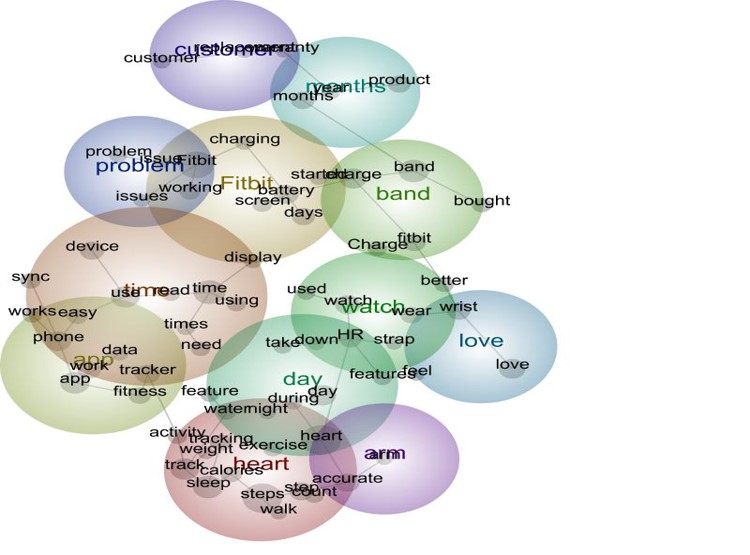
For one of my research projects, We have analyzed 40,000 Amazon Reviews of Smart Wearable Devices like Fit Bit, Samsung Gear 2, and 3. The Following output provides us an idea, what people are talking about your brands or products. It may be difficult to go through 40,000 reviews because of a large volume of unstructured data. With the help of Automatic Content Analysis, you can easily understand what is important to your customers.
When it comes to Keywords, as a brand or e-commerce website, you should ask yourself the following questions:
WHAT type of keywords do customers type/use when they are searching for something ?How do they type them ?Where do they type them ?
We can use some free tools such as Google Trends and Google Ads Keyword Planner for more insights. There are also many others : Ubbersuggest, Keyword Tool, Soovle, SEMrush (Premium), Wordstream Keyword Tools (premium), MOZ Keyword Difficulty (Premium), etc. Each of them has its own advantages and/or disadvantages. However, choosing one over the other is down to personal preference and previous experience.
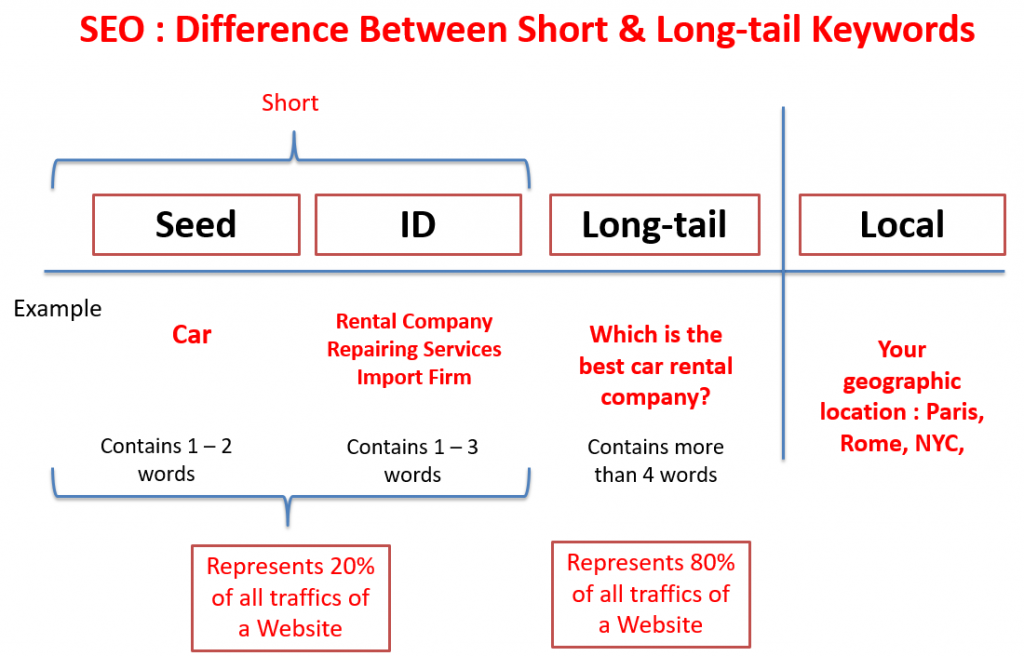
Usually, we can have two types of keyword: Short & Long-tail. Long-tail keywords usually represent 80% of all traffics of a Website. They help companies to attract qualified audience (people who are exactly looking for your product/service). In addition, the competition is often low for these keywords and companies will have a better ROI.
A picture can tell thousands of words. Can we analyze images posted on social media and review platforms? Yes, we can. With the advancement of the Artificial Intelligence area, researchers can use deep learning to understand images. We have used deep learning to Investigate the Digital Behaviour of consumers.
In this research, 4,000 photos of nine Chinese restaurants posted on Tripadvisor’s website were analyzed using image recognition via Inception V3 and Google’s deep learning network; this revealed 12 hierarchical image clusters. Two examples of these clusters are provided below-
Cluster Name: Atmospheric cluster This cluster of images is generated through the help of deep learning.
Cluster Name: Decorations using lamps in Restaurants This cluster of images is generated through the help of deep learning.
The above clusters provided us an idea of what type contents consumers are posting on social media. These will also help restaurants to formulate different strategies such as improving the atmospheric environment and decorating using lamps. Competitors can also learn about their competitors by analyzing the images posted by consumers on online platforms.
To know more about this research, please read my following article-
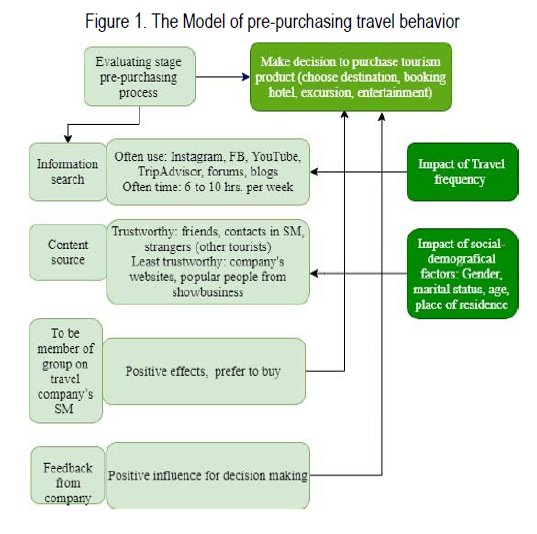
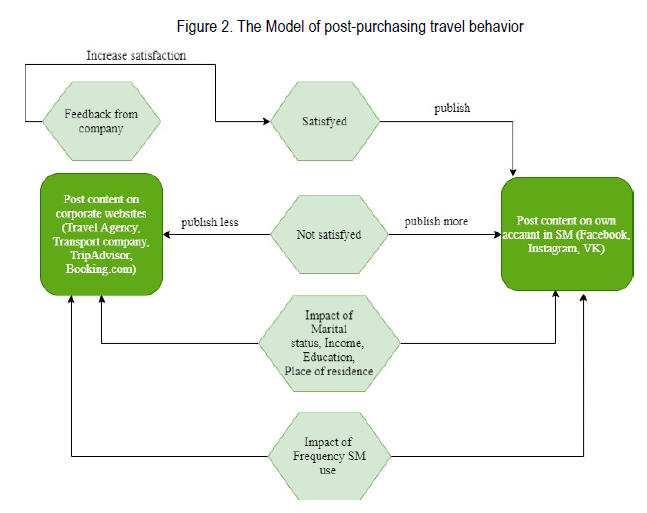
The following Figures represent consumers’ travel behavior on Social Media (SM). This can be used as a tool to formulate your social media strategies.
To know more details, read my following co-authored article-
ABDUNUROVA, A., USPANOVA, M., HASAN, R., SURAPBERGENOVA, Z., & KUDAIBERGENOV, N. (2020). Pre-Purchasing and Post-Purchasing Travel Behavior on Social Media: The Case of Kazakhstan. Journal of Environmental Management and Tourism, 11(6), 1475-1488.
The Google Ads Keyword Planner is not only effective for SEA, but also for SEO. This free tool allows Marketing Professionals to research potential keywords to use in their campaigns and ad groups. In this Video, B. Mangold (from Loves Data) explains how you can use the Google Ads Keyword Planner and choose right keyword suggestions in order to reach your target group.
Please note that in order to use Keyword Planner effectively, you will need to enter billing details for the account and have an active campaign. If you don’t, then you won’t see precise data in the tool.
Some of you might not be very familiar with “Google Search” and as Digital Marketing Professors, we have found that it is not very clear to our students although they do spend a lot of time on Searching information/things on Google/Bing… (and on other Search Engines). So, we share this small video from “Google”, which is very well illustrated with the examples and we hope that it will help you to know about how Google Search works, including how Google’s software indexes the web, ranks sites, flags spam, and serves up results.
We use cookies on our website to give you the most relevant experience by remembering your preferences and repeat visits. By clicking “Accept All”, you consent to the use of ALL the cookies. However, you may visit "Cookie Settings" to provide a controlled consent.
This website uses cookies to improve your experience while you navigate through the website. Out of these, the cookies that are categorized as necessary are stored on your browser as they are essential for the working of basic functionalities of the website. We also use third-party cookies that help us analyze and understand how you use this website. These cookies will be stored in your browser only with your consent. You also have the option to opt-out of these cookies. But opting out of some of these cookies may affect your browsing experience.
Necessary cookies are absolutely essential for the website to function properly. These cookies ensure basic functionalities and security features of the website, anonymously.
Cookie
Duration
Description
cookielawinfo-checkbox-analytics
11 months
This cookie is set by GDPR Cookie Consent plugin. The cookie is used to store the user consent for the cookies in the category "Analytics".
cookielawinfo-checkbox-functional
11 months
The cookie is set by GDPR cookie consent to record the user consent for the cookies in the category "Functional".
cookielawinfo-checkbox-necessary
11 months
This cookie is set by GDPR Cookie Consent plugin. The cookies is used to store the user consent for the cookies in the category "Necessary".
cookielawinfo-checkbox-others
11 months
This cookie is set by GDPR Cookie Consent plugin. The cookie is used to store the user consent for the cookies in the category "Other.
cookielawinfo-checkbox-performance
11 months
This cookie is set by GDPR Cookie Consent plugin. The cookie is used to store the user consent for the cookies in the category "Performance".
viewed_cookie_policy
11 months
The cookie is set by the GDPR Cookie Consent plugin and is used to store whether or not user has consented to the use of cookies. It does not store any personal data.
Functional cookies help to perform certain functionalities like sharing the content of the website on social media platforms, collect feedbacks, and other third-party features.
Performance cookies are used to understand and analyze the key performance indexes of the website which helps in delivering a better user experience for the visitors.
Analytical cookies are used to understand how visitors interact with the website. These cookies help provide information on metrics the number of visitors, bounce rate, traffic source, etc.
Advertisement cookies are used to provide visitors with relevant ads and marketing campaigns. These cookies track visitors across websites and collect information to provide customized ads.